SlimSet Official Website › Supplement Facts
Supplement FactsSlimSet Supplement Facts
The SlimSet panel prints one capsule as a serving, thirty to a container, and five actives with a milligram figure against each.
Green coffee, raspberry ketone, garcinia and green tea sit at 130 mg; caffeine anhydrous sits at 138 mg. Three rows carry a standardisation percentage, so the compound each one delivers can be worked out exactly.
The panel as the bottle prints it, then the arithmetic the printed percentages make possible.
What does the SlimSet Supplement Facts panel print?
Serving size one capsule, thirty per container, five actives and an amount against every one of them.
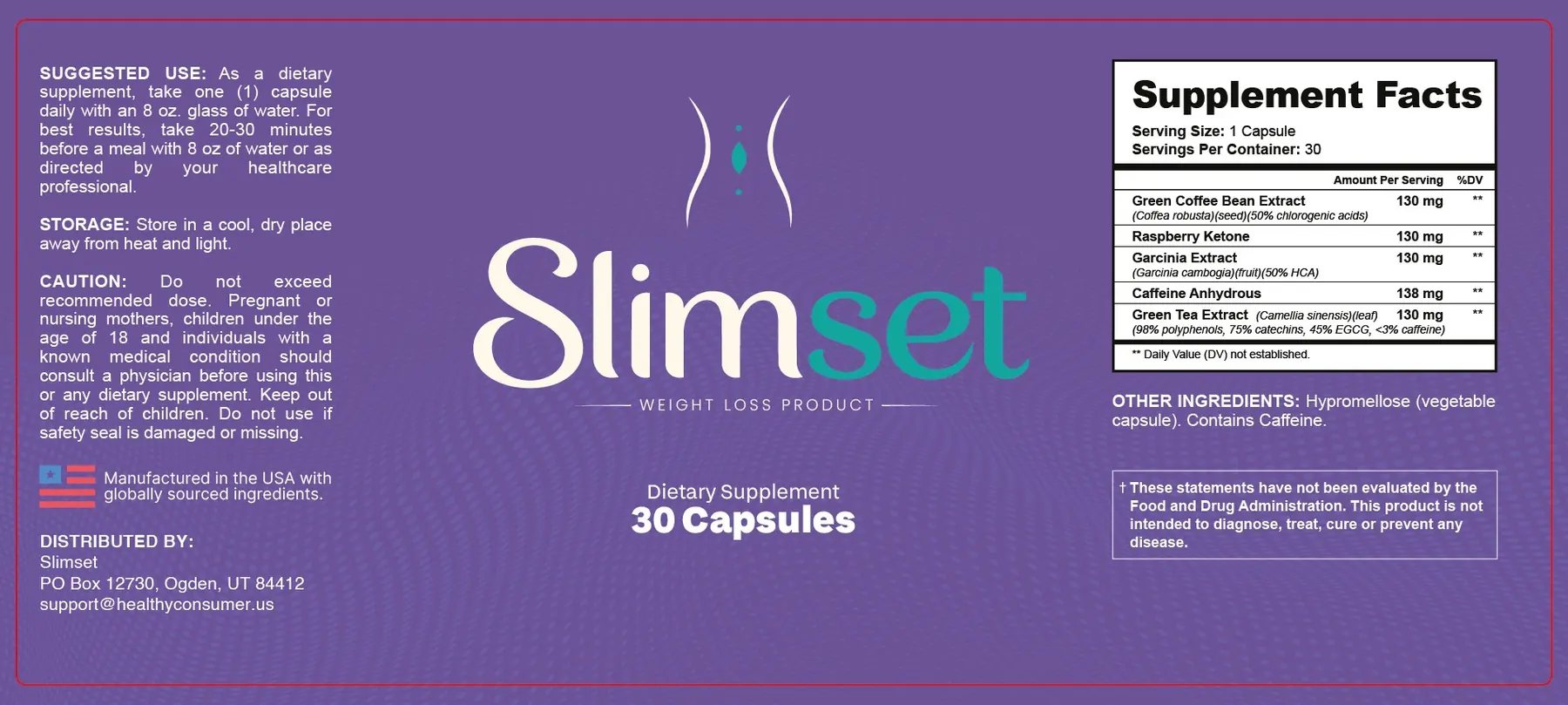
One serving is one capsule and a container holds thirty of them, so the panel describes a single day and a bottle describes a month. Five rows sit under the serving line, each with a milligram figure beside it.
Three of those rows also print a standardisation in brackets, which is the percentage of the named compound the extract is made up to. That bracket is what turns a plant name into a number you can work with.
The five rows on the SlimSet panel, exactly as the bottle prints them
Five names, five amounts, one footnote mark against each of them.
| Amount per serving | Per capsule | % Daily Value |
|---|---|---|
| Green Coffee Bean Extract (Coffea robusta) (seed) (50% chlorogenic acids) | 130 mg | † |
| Raspberry Ketone | 130 mg | † |
| Garcinia Extract (Garcinia cambogia) (fruit) (50% HCA) | 130 mg | † |
| Caffeine Anhydrous | 138 mg | † |
| Green Tea Extract (Camellia sinensis) (leaf) (98% polyphenols, 75% catechins, 45% EGCG, under 3% caffeine) | 130 mg | † |
† Daily Value (DV) not established, printed against all five rows. A Daily Value is a reference figure the FDA sets for nutrients such as vitamin C or iron. Botanical extracts and caffeine have none, which is why every row on this panel carries the same footnote mark.
Added together the five rows come to 658 mg of declared active material in one capsule. The largest single row is caffeine anhydrous at 138 mg, which is more than any of the four botanicals beside it.
Under the panel sit two more lines. Other ingredients: hypromellose (vegetable capsule), which is the shell itself and the only inactive material in the bottle. Then the allergen-style statement, contains caffeine, printed because caffeine at this level is worth flagging to somebody scanning a shelf.
What do the SlimSet standardisation percentages convert to?
Three of the five rows print a percentage. Here is what each one comes to once it is applied to the milligram figure beside it.
A percentage in brackets is a promise about concentration, not about weight. Fifty per cent chlorogenic acids on a 130 mg row means 65 mg of chlorogenic acids and 65 mg of everything else the bean carried through the extraction.
Green tea is the row that carries three percentages at once, because polyphenols, catechins and EGCG are nested inside one another: all the EGCG is a catechin, all the catechins are polyphenols. Working each one out separately is how the same 130 mg row produces three different useful figures.
| Compound | Where the figure comes from | Per capsule |
|---|---|---|
| Chlorogenic acids | 50% of 130 mg of green coffee extract | about 65 mg |
| Hydroxycitric acid | 50% of 130 mg of garcinia extract | about 65 mg |
| EGCG | 45% of 130 mg of green tea extract | about 58.5 mg |
| Total catechins | 75% of 130 mg of green tea extract | about 97.5 mg |
| Green tea polyphenols | 98% of 130 mg of green tea extract | about 127 mg |
| Caffeine, declared | the caffeine anhydrous row, printed in full | 138 mg |
| Caffeine, undeclared | carried by the green coffee and green tea extracts | under 3.9 mg from the tea; the coffee figure is not published |
Every figure here is the label's own percentage applied to the label's own milligram row. Nothing is estimated and nothing is rounded up.
Caffeine anhydrous is 138 mg of powder added on purpose. Green tea extract is capped at under three per cent caffeine, which puts about 3.9 mg more in the capsule, and green coffee extract carries some as well without a percentage beside it. A cup of brewed coffee runs 80 to 100 mg, so one capsule is already ahead of a mug before anything else in the day is counted.
How do the SlimSet amounts compare with the doses the research used?
One column is the label. The other is what the trials behind these ingredients gave people, at what daily amount, for how long.
Setting a label figure beside a trial figure is the single most useful thing a page like this can do, and it is only possible because every row here carries a number. The comparison below runs in one direction: what one capsule delivers a day, against the daily amount the published work actually gave people.
One figure on this bottle lands inside a researched range, and it is the caffeine. 138 mg a day sits beside the 150 mg arm in the 1999 thermogenesis trial, which was included as the comparator rather than the treatment and behaved like one.
The four botanicals land below their comparison doses by factors ranging from five to twenty-three. Raspberry ketone has no human weight trial at any dose, so there is nothing to set it against at all, which is covered in the 2022 review of what is known about it.
A dose below the researched one is not evidence the capsule does nothing. It is evidence that the published work cannot be used to predict what it does. Those are different statements, and only the second one is supportable from a panel. The sixty-day window exists so the question can be answered on your own body rather than on an average.
What else is printed on the SlimSet bottle?
Four blocks of small print, and every one of them changes how a bottle should be handled.
Suggested use
“As a dietary supplement, take one (1) capsule daily with an 8 oz. glass of water. For best results, take 20-30 minutes before a meal with 8 oz of water or as directed by your healthcare professional.” A range rather than a fixed clock time, and a full glass of water attached to it. Whichever meal you pick, the same meal every day is what makes a bottle comparable with the one before it.
Storage
“Store in a cool, dry place away from heat and light.” A kitchen cupboard away from the hob, not a window sill and not the bathroom. Catechins and chlorogenic acids are both sensitive to heat and light over months.
The caution
“Do not exceed recommended dose. Pregnant or nursing mothers, children under the age of 18 and individuals with a known medical condition should consult a physician before using this or any dietary supplement. Keep out of reach of children. Do not use if safety seal is damaged or missing.” Reproduced here word for word because it is printed on the bottle you receive.
Who makes it and who sells it
The label carries Slimset, PO Box 12730, Ogden, UT 84412, with [email protected] beside it, and the line “Manufactured in the USA with globally sourced ingredients”. That is a separate company from this desk. Our lot reference for the stock here is SLI-26/MY-3272.
The front of the bottle prints two short lines and no third. “Weight Loss Product” sits under the brand, “Dietary Supplement” sits under that, and the FDA box runs along the back. Appetite control, everyday fat metabolism and steady energy are the seller’s descriptions on the seller’s page, and the benefits page sets out which of the three has an ingredient at a trial-comparable amount underneath it.
How to read the SlimSet panel against any other bottle
The same five moves work on any Supplement Facts panel in any shop.
Find the serving size first
Everything on a panel is per serving, and a serving is whatever the manufacturer says it is. One capsule here. A competitor quoting a bigger number on a two-capsule serving is quoting half as much per capsule, and the two figures look identical on a shelf.
Read the bracket before the milligram
A 130 mg row standardised to 50% delivers 65 mg of the compound anybody is actually buying. A 500 mg row with no bracket may deliver less than that, and there is no way to tell from the outside.
Count the caffeine twice
Once from the row that names it, and once from every extract that carries it quietly. Green tea, green coffee, guarana and yerba mate all do. An analysis of commercial thermogenic capsules found declared and measured caffeine drifting apart in both directions.
Check the plant part and the species
Coffea robusta seed and Camellia sinensis leaf are both printed here in brackets. Where a label names only the genus, the research it borrows its reputation from may have used a different part of the same plant.
Then look up one trial, not ten
Pick the single ingredient the bottle leans hardest on, find the dose its best trial used, and compare. The consumer guide at the NIH Office of Dietary Supplements is a short and genuinely readable starting point.
SlimSet panel questions
Does SlimSet use a proprietary blend?
No. Every one of the five actives carries its own milligram figure, and nothing is grouped behind a blend name. That is the reason the conversions above can be done at all: a blend would give one total for five ingredients and no way to split it.
Why does every row on the SlimSet panel have the same footnote mark?
Because a Daily Value has only been set for nutrients such as vitamins and minerals. Botanical extracts, raspberry ketone and caffeine have no reference figure to be a percentage of, so the panel prints the footnote mark against all five rows and explains it underneath.
How much caffeine is in one SlimSet capsule in total?
138 mg is declared as caffeine anhydrous. The green tea extract adds about 3.9 mg at its stated cap of under three per cent, and the green coffee extract adds an amount the seller gives no percentage for. The honest total is 138 mg plus a small unquantified remainder.
Is the SlimSet capsule shell suitable for a vegetarian diet?
The shell is hypromellose, which is made from plant cellulose, and it is the only inactive ingredient in the bottle. There is no gelatin anywhere in it. The label prints no vegetarian certification mark, and testing and quality goes through which marks on this pack are backed by a document.
Can I take two SlimSet capsules a day to reach the trial doses?
The label sets one capsule a day and also prints “do not exceed recommended dose”. Doubling would put 276 mg of declared caffeine into one day before coffee, and it would still leave the garcinia at a fraction of the amount the JAMA trial used. It moves the risk a long way and the comparison very little.
Where can I see the SlimSet panel for myself?
On the bottle, and in the label photograph at the top of this page. The artwork above is the same flat file the seller supplies to stockists, so the rows, the brackets and the footnote read exactly as they do on the container in your hand.
Sources behind the SlimSet panel comparison
The trials whose daily doses appear in the comparison above, and the label artwork itself.
- SlimSet product label artwork, supplied in the vendor asset pack. Serving size one capsule, 30 per container. Distributed by Slimset, PO Box 12730, Ogden, UT 84412.
- Kanchanasurakit S, Saokaew S, Phisalprapa P, et al. Chlorogenic acid in green bean coffee on body weight: a systematic review and meta-analysis of randomized controlled trials. Syst Rev. 2023;12(1):163. PMID 37710316. https://pubmed.ncbi.nlm.nih.gov/37710316/
- Heymsfield SB, Allison DB, Vasselli JR, et al. Garcinia cambogia (hydroxycitric acid) as a potential antiobesity agent: a randomized controlled trial. JAMA. 1998;280(18):1596-600. PMID 9820262. https://pubmed.ncbi.nlm.nih.gov/9820262/
- Dulloo AG, Duret C, Rohrer D, et al. Efficacy of a green tea extract rich in catechin polyphenols and caffeine in increasing 24-h energy expenditure and fat oxidation in humans. Am J Clin Nutr. 1999;70(6):1040-5. PMID 10584049. https://pubmed.ncbi.nlm.nih.gov/10584049/
- Maki KC, Reeves MS, Farmer M, et al. Green tea catechin consumption enhances exercise-induced abdominal fat loss in overweight and obese adults. J Nutr. 2009;139(2):264-70. PMID 19074207. https://pubmed.ncbi.nlm.nih.gov/19074207/
- Li X, Wei T, Wu M, et al. Potential metabolic activities of raspberry ketone. J Food Biochem. 2022;46(1):e14018. PMID 34913499. https://pubmed.ncbi.nlm.nih.gov/34913499/
- Longhi GS, Crocoli LC, Armando YP, et al. Too much or too little caffeine? Determination of content in thermogenic capsules by quantitative 1H nuclear magnetic resonance (qNMR). J Pharm Biomed Anal. 2025;261:116832. PMID 40179616. https://pubmed.ncbi.nlm.nih.gov/40179616/
Order SlimSet with the panel already read
Five printed amounts, one capsule a day, 30 to a bottle, and 60 days from purchase to decide.
One bottle $89 · six bottles $294 · 60-day money-back guarantee
Order SlimSet On The Official WebsiteOne capsule a day · 30 per bottle · lot SLI-26/MY-3272