SlimSet Official Website › Blog › How To Read A Standardised Label
How To Read A Standardised Supplement Label
Almost everything a buyer needs is printed on the back of the bottle, in a box nobody reads. Four habits turn that box from decoration into data, and once you have them they work on any supplement in any shop, not just this one.
Habit one: find the serving size
Every figure on a Supplement Facts panel is per serving, and a serving is not always one capsule. Two-capsule and three-capsule servings are common, and a panel that looks generous at a glance can be describing three capsules a day from a bottle of sixty.
The serving size sits at the top of the panel, with servings per container beside it. Those two numbers together tell you how long a bottle lasts, which is the only honest basis for comparing prices between products.
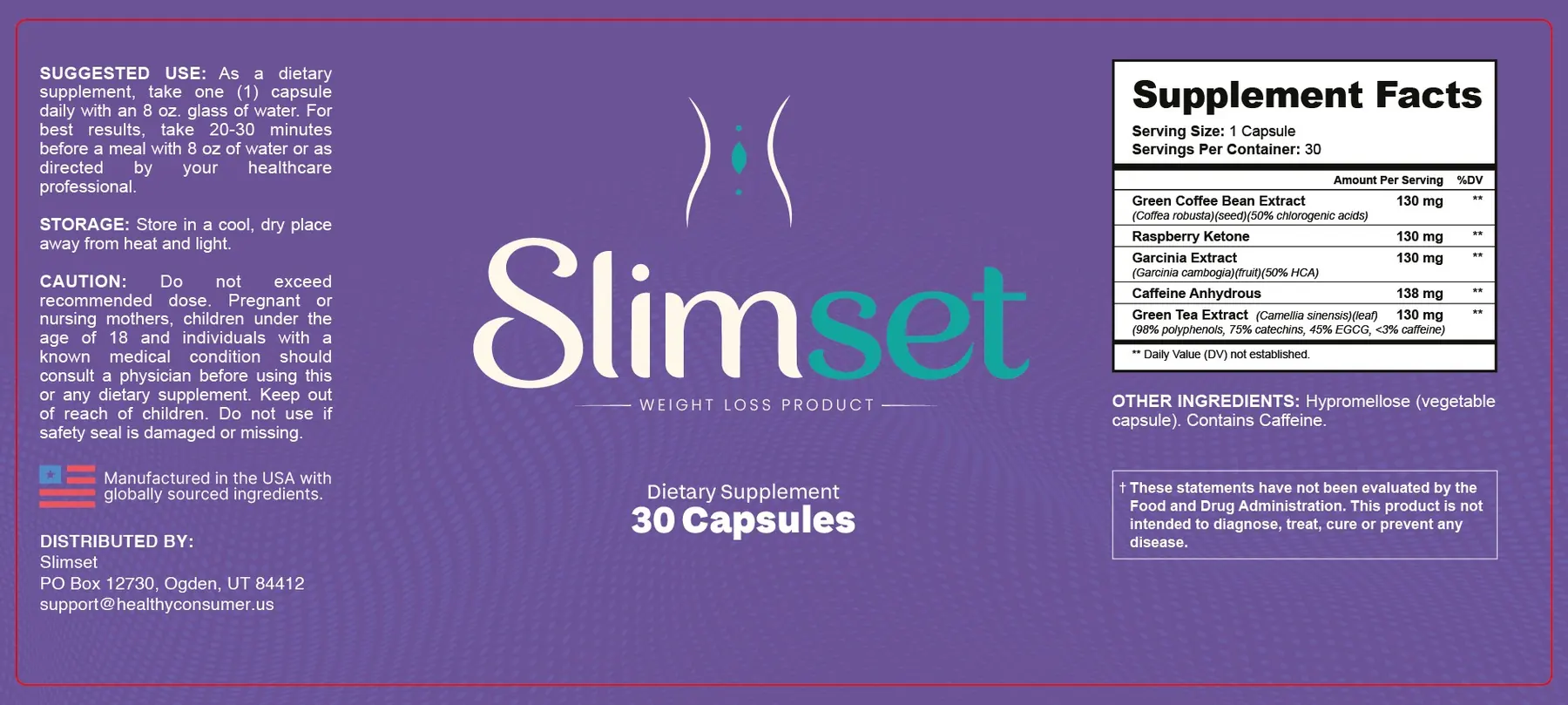
On this label the serving is one capsule and there are 30 per container, so every printed figure is also a daily figure and a bottle is a month. That is unusually easy to work with, and it is worth noticing when a label makes your life easy.
Habit two: find the amount
An ingredient name with no milligram figure beside it is an ingredient list rather than a dose. It tells you something is present and nothing about how much, which means no comparison with any study is possible.
The worst version of this is the proprietary blend: several ingredients grouped under one heading with a single total. A 500 mg blend of five botanicals could be 496 mg of the cheapest one and a milligram each of the rest, and the panel would be entirely accurate. Blends are legal and they are also the single biggest obstacle to evaluating a supplement.
A panel with a separate figure against every active is doing the buyer a real favour, and it is the first thing to look for.
- Find the serving size, because every number depends on it.
- Find the amount, because a name without a number is not a dose.
- Read the bracket, because a percentage turns a plant into a compound.
- Compare the result with a published dose, because that is the only benchmark.
Habit three: read the bracket
This is the habit almost nobody has and it is the one that does the work. A bracket after an ingredient name usually contains the plant part, the extract ratio or the standardisation, and the standardisation is the valuable one.
Standardised to 50 per cent chlorogenic acids means the extract is half chlorogenic acids by weight. Applied to a 130 mg row, that is 65 mg of the compound and 65 mg of everything else the plant carried through. The research is almost always about the compound rather than about the extract, so this conversion is what makes a comparison possible at all.
Without the bracket, 130 mg of green coffee extract could be 5 per cent chlorogenic acids or 60 per cent, a twelvefold range. An analysis of commercial green coffee extracts found the actual content of products on sale varied widely from what was claimed, which is a reminder that a printed percentage is a manufacturing claim rather than a measurement, and still far better than nothing.
The nesting trick
Green tea is the row that catches people out, because it often carries several percentages at once and they are not additive. Polyphenols, catechins and EGCG are nested inside one another: all the EGCG is a catechin, and all the catechins are polyphenols.
So a row reading 98 per cent polyphenols, 75 per cent catechins and 45 per cent EGCG is not describing 218 per cent of anything. It is describing three concentric circles, and each percentage converts separately into a different useful figure.
Which one you want depends on what you are comparing against. The chamber trial reported its dose as EGCG, so EGCG is the figure to convert when comparing with it. A catechin trial wants the catechin figure. Converting the wrong one is the commonest arithmetic error in this whole exercise.
What the daggers and footnotes mean
A percentage Daily Value column appears on every Supplement Facts panel, and on a botanical product most of it is empty. A Daily Value is a reference figure set for nutrients such as vitamin C, calcium or iron. Botanical extracts and caffeine have none.
So a footnote mark against every row, with a note saying a Daily Value has not been established, is not a criticism of the product. It is a statement about what has been regulated, and it appears on almost every herbal supplement ever made.
What it does mean in practice is that no reference amount exists to judge the row against. The only benchmark available is the dose a study used, which is why habit four matters more on a botanical panel than on a multivitamin.
The other ingredients line
Underneath the panel sits a line naming everything that is not an active: shells, fillers, flow agents, colours. It is short here and worth reading everywhere.
On this label it reads hypromellose (vegetable capsule), which is the capsule shell and nothing else. Hypromellose is plant-derived, so the capsule suits a vegetarian diet even though the label makes no vegetarian claim of its own.
Below that sits an allergen-style statement. Here it is “Contains Caffeine.”, printed because caffeine at this level is worth flagging to somebody scanning a shelf. Measured caffeine content in capsules of this kind has been found to differ from declared figures often enough that a declared number is best treated as a floor.
The whole panel, worked through
| Panel row | The bracket | The sum | What one capsule delivers |
|---|---|---|---|
| Green coffee bean extract 130 mg | 50% chlorogenic acids | 0.50 × 130 | about 65 mg |
| Garcinia extract 130 mg | 50% HCA | 0.50 × 130 | about 65 mg |
| Green tea extract 130 mg | 45% EGCG | 0.45 × 130 | about 58.5 mg |
| Green tea extract 130 mg | 75% catechins | 0.75 × 130 | about 97.5 mg |
| Green tea extract 130 mg | 98% polyphenols | 0.98 × 130 | about 127 mg |
| Raspberry ketone 130 mg | No bracket needed | It is the compound | 130 mg |
| Caffeine anhydrous 138 mg | No bracket needed | It is the compound | 138 mg |
One row can produce three different useful figures, because polyphenols, catechins and EGCG are nested inside one another.
Seven lines of arithmetic, no equipment, about two minutes. That is the entire skill, and the result is a set of figures that can be set beside published doses.
Doing exactly that produces the comparison this website is built around. About 65 mg of chlorogenic acids against the 500 mg a day where the pooled result appears. About 58.5 mg of EGCG against the 270 mg behind the chamber result. And the EGCG figure sitting below the range the USP panel associates with case reports, which is the same arithmetic producing a reassuring answer rather than an unflattering one.
| What the panel looks like | What you can work out | What to do |
|---|---|---|
| A proprietary blend with one total | Nothing about any single ingredient | Treat every ingredient claim as unsupported |
| Named ingredients, no amounts | Only what is present, not how much | The same, with better manners |
| Named ingredients with amounts, no brackets | The extract weight only | Ask the seller for the standardisation |
| Amounts plus standardisations | The compound the research studied | Do the sum and compare it with a trial dose |
| A single ingredient at a researched dose | Everything | Rare, and usually the cheapest option too |
Five shapes, in ascending order of how much a buyer can verify. Most of the shelf sits in the top two rows.
What a panel still cannot tell you
Four limits are worth stating, because a reader who has just learned this skill will reasonably overestimate it.
- A printed amount is a manufacturing claim, not a measurement. Without a certificate of analysis, nobody has verified what is in the bottle.
- A panel says nothing about whether the ingredients interact with each other or with a medicine.
- Matching a trial dose would not make a capsule equivalent to the trial product, which may have used a different extract entirely.
- No panel can tell you whether a finished multi-ingredient formula has ever been tested. In this category it almost never has.
With those limits stated, the skill is still the best thing a buyer has. It separates the labels that can be checked from the ones that cannot, and it converts a marketing page into a set of numbers you can look up.
Applied to the bottle this website sells, it produces a mixed answer: a panel that can be checked, amounts that mostly fall short of the research, one figure that is genuinely reassuring, and a caffeine row that is the largest thing on the label. All four of those are better to know than not to know.
References
- SlimSet product label artwork, supplied in the vendor asset pack. Serving size one capsule, 30 per container. Distributed by Slimset, PO Box 12730, Ogden, UT 84412.
- Vinson JA, Chen X, Garver DD. Determination of total chlorogenic acids in commercial green coffee extracts. J Med Food. 2019;22(3):314-320. PMID 30888913. https://pubmed.ncbi.nlm.nih.gov/30888913/
- Longhi GS, Crocoli LC, Armando YP, et al. Too much or too little caffeine? Determination of content in thermogenic capsules by quantitative 1H nuclear magnetic resonance (qNMR). J Pharm Biomed Anal. 2025;261:116832. PMID 40179616. https://pubmed.ncbi.nlm.nih.gov/40179616/
- Oketch-Rabah HA, Roe AL, Rider CV, et al. United States Pharmacopeia (USP) comprehensive review of the hepatotoxicity of green tea extracts. Toxicol Rep. 2020;7:386-402. PMID 32140423. https://pubmed.ncbi.nlm.nih.gov/32140423/
- Kanchanasurakit S, Saokaew S, Phisalprapa P, et al. Chlorogenic acid in green bean coffee on body weight: a systematic review and meta-analysis of randomized controlled trials. Syst Rev. 2023;12(1):163. PMID 37710316. https://pubmed.ncbi.nlm.nih.gov/37710316/
- Dulloo AG, Duret C, Rohrer D, et al. Efficacy of a green tea extract rich in catechin polyphenols and caffeine in increasing 24-h energy expenditure and fat oxidation in humans. Am J Clin Nutr. 1999;70(6):1040-5. PMID 10584049. https://pubmed.ncbi.nlm.nih.gov/10584049/