SlimSet Official Website › Blog › Vegetable Capsule Vs. Gelatin
Vegetable Capsule Vs. Gelatin: What The Disintegration Studies Show
The “other ingredients” line on this panel names exactly one thing: hypromellose. That is a plant-derived capsule shell, not the gelatin most capsules have used for a century. Pharmaceutical science has measured, with a stopwatch and a gamma camera, how a hypromellose shell opens compared with a gelatin one — empty-stomach and after food. The results are more interesting than a simple “same or different” answer.
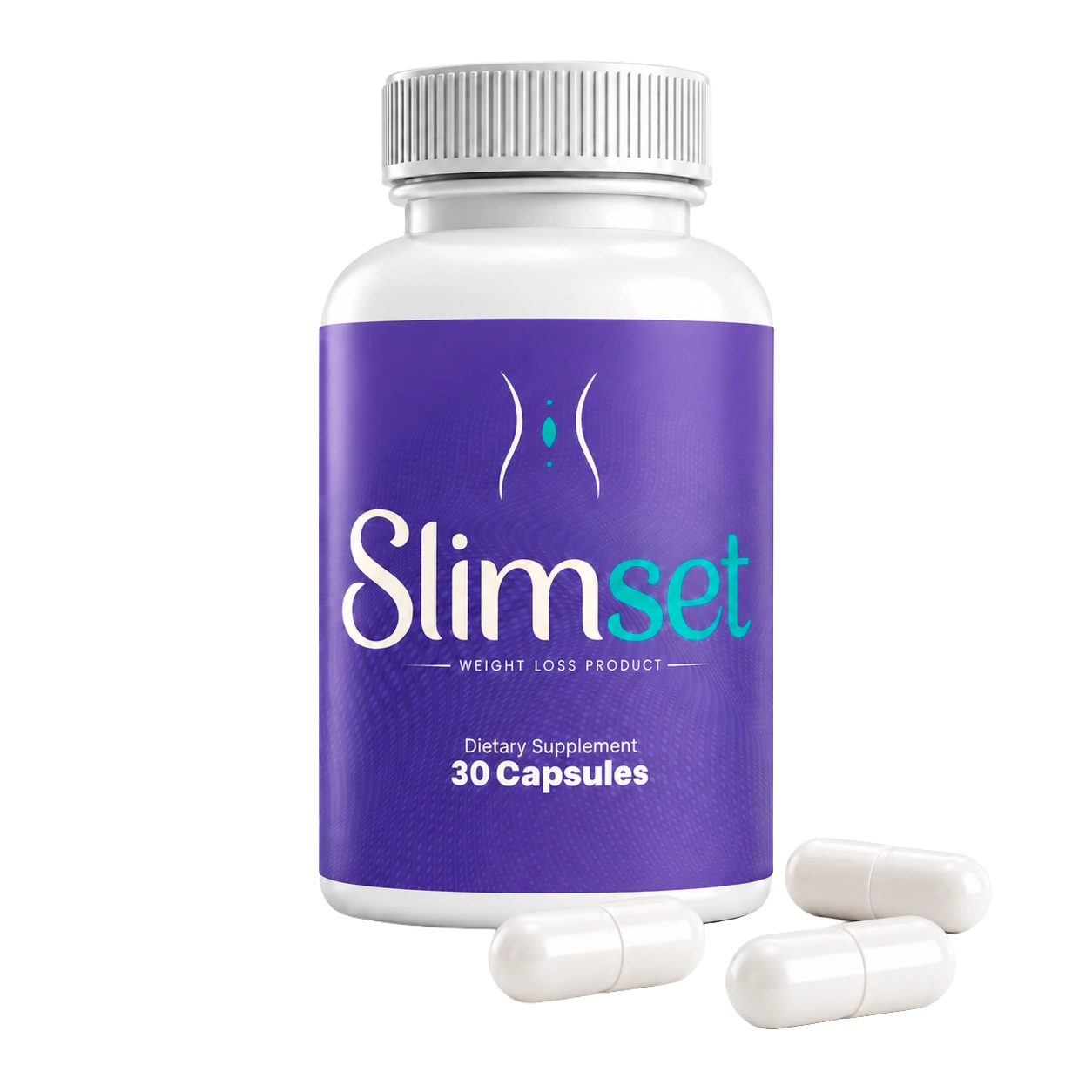
- This shell is hypromellose (HPMC), a plant-cellulose derivative used as an alternative to gelatin. There is no gelatin anywhere in the bottle.
- In one comparative study, gelatin capsules began disintegrating within about 3 minutes; the two hypromellose variants tested began within about 6 minutes.
- In a separate gamma-scintigraphy study in fasted volunteers, hypromellose(carrageenan) capsules disintegrated in 8±2 minutes against 7±3 minutes for gelatin — not a statistically significant difference.
- After food, both shell types slowed down: 16±5 minutes for hypromellose(carrageenan) versus 12±4 minutes for gelatin, again not statistically significant.
- A newer hypromellose formulation without a gelling agent was found to dissolve its contents faster and more consistently than the carrageenan-gelled version, in a separate performance-qualification study.
What the panel actually says about the shell
Five active rows sit on this label, each with its own printed milligram figure. Underneath them sits one more line, easy to skip past: “Other ingredients: Hypromellose (vegetable capsule).” That line is the entire inactive side of the formula. Hypromellose, also called HPMC or hydroxypropyl methylcellulose, is a modified plant cellulose used across the pharmaceutical and supplement industry as a shell material that does not require an animal-derived gelling agent. There is no gelatin anywhere in this bottle, which is the reason the label can call the capsule suitable for a vegetarian diet without a separate certification mark.
What the label does not say is which specific hypromellose formulation is used, whether it contains a secondary gelling agent such as carrageenan, or which manufacturer supplies it. That detail matters for reading the research below honestly: the published studies compare named, specific capsule types, and this label does not identify itself against any one of them. What follows is general pharmaceutical-science evidence about hypromellose shells as a category, set beside gelatin as a category, not a claim about this exact shell's own unpublished specification.
Why hypromellose exists as an alternative
Gelatin capsules have been the pharmaceutical industry's default for close to a century, made from hydrolysed collagen sourced from bovine or porcine tissue. That sourcing is exactly why an alternative was developed: gelatin is not vegetarian, not vegan, and carries religious dietary restrictions for some buyers. Hypromellose answers all three by starting from plant cellulose rather than animal collagen, while trying to match gelatin's mechanical performance — a shell that survives filling, shipping and shelf life, then opens reliably once swallowed.
Matching that performance is a genuine engineering problem, not a formality. A shell has to hold its shape dry, resist cracking, and then disintegrate on a predictable schedule once it meets stomach fluid. The three studies below are exactly that kind of engineering comparison, run by pharmaceutical scientists rather than by either industry's marketing department.
Study one: disintegration and dissolution, side by side
A 2015 study in Drug Development and Industrial Pharmacy tested three capsule types in vitro: hard gelatin capsules (Capsule 1), hypromellose capsules made with a gelling agent (Capsule 2), and hypromellose capsules made without one (Capsule 3). The team measured shell weight variation, moisture behaviour under different humidity conditions, powder leakage, disintegration time, and dissolution of an acetaminophen test filling.
| Capsule type | Initial disintegration (n=18) | Dissolution of test filling |
|---|---|---|
| Hard gelatin (Capsule 1) | Within about 3 minutes | Fastest, over 90% in 10 minutes; not sensitive to media pH |
| Hypromellose with gelling agent (Capsule 2) | Within about 6 minutes | Slower; influenced by the pH and contents of the dissolution medium |
| Hypromellose without gelling agent (Capsule 3) | Within about 6 minutes | Not significantly affected by water temperature, unlike gelatin |
Figures read from the study's own reported results for its three tested capsule types, not from this label, which does not specify which hypromellose formulation it uses.
The gelatin capsule disintegrated fastest and dissolved its contents most predictably across conditions in this particular in-vitro test. Both hypromellose types took roughly twice as long to begin disintegrating, and the gelling-agent version showed dissolution that depended more on the surrounding fluid's pH. The authors' own conclusion was not that hypromellose fails, but that there was, in their words, “a window for capsule shells manufacturing companies to improve the dissolution of their hypromellose capsules to match the conventional gelatin capsule shells.”
The same study also measured something rarely discussed on a supplement label: shell weight variation and moisture behaviour under different humidity conditions. Weight variability was low across all three shell types, which is a good result — it means capsules of a given type are filled consistently rather than some running heavier or lighter than others. Gelatin absorbed the most moisture of the three when exposed to different humidity levels, which fits its reputation as the more hygroscopic material. What the researchers also found, and what matters more for anyone storing a bottle on a bathroom shelf, is that none of the three shell types could fully protect a moisture-sensitive powder filling from ambient humidity. Shell material changed the degree of that exposure; it did not eliminate it. That is a reason a dry, capped bottle away from a steamy bathroom is worth doing regardless of which capsule shell a product uses, not a finding specific to any one brand.
Study two: a gamma camera, fasted and fed
Numbers from a beaker do not always describe what happens inside a living stomach, which is why a second study, published in the International Journal of Pharmaceutics, used gamma scintigraphy — radiolabelled capsules tracked with a gamma camera — in eight healthy male volunteers. Hypromellose(carrageenan) and gelatin capsules were radiolabelled separately and given simultaneously with 180 ml of water, once after an overnight fast and once after food.
| Condition | Hypromellose (carrageenan) | Gelatin | Statistically different? |
|---|---|---|---|
| Fasted | 8 ± 2 minutes | 7 ± 3 minutes | No |
| Fed | 16 ± 5 minutes | 12 ± 4 minutes | No |
Mean disintegration time ± standard deviation, read from the study's own reported results.
Two findings are worth separating here. First, in living subjects rather than a beaker, the gap between hypromellose and gelatin narrowed to the point of not being statistically significant in either condition — a different picture from the roughly two-to-one gap the in-vitro study above found. Second, and more relevant to this label's own directions, food itself made a much bigger difference than shell material did: both capsule types roughly doubled their disintegration time when taken after a meal instead of on an empty stomach.
Study three: a newer hypromellose, built to dissolve faster
The 2015 in-vitro study's own conclusion — that hypromellose had room to catch up to gelatin — is exactly the problem a 2010 study in the International Journal of Pharmaceutics set out to solve. Researchers at a major pharmaceutical company qualified a new hypromellose capsule shell, built without a gelling agent and marketed as “dissolution friendly,” against both a carrageenan-gelled hypromellose capsule and a standard gelatin capsule.
The new formulation showed improved weight variation, better machinability, and less powder leakage than the carrageenan-gelled hypromellose capsule it was compared against, and the authors reported it as demonstrating superior mechanical strength, lower hygroscopicity, and broader compatibility with different drug fills than either of the other two shell types. By the time of publication, it had already been used successfully in filling formulations for close to twenty different investigational drug compounds.
The practical point for a reader of this label is not which specific brand of shell sits inside this bottle — that detail is not published anywhere this site has access to. It is that “hypromellose capsule” is not one single, fixed material with one fixed disintegration speed. The category includes formulations that were, at the time of the first study above, measurably slower than gelatin, and newer formulations engineered specifically to close that gap.
Read the full panel this shell surrounds
Five actives, each with a printed milligram figure and, for three of them, a standardisation carried through to what it delivers against the published research.
One bottle $89 · six bottles $294 · 60-day money-back guarantee
Order SlimSetOne capsule a day · 30 per bottle
What none of these studies tested
None of the three studies above tested this specific bottle, this specific formulation of hypromellose, or a capsule filled with green coffee bean extract, garcinia extract, green tea extract, raspberry ketone and caffeine anhydrous. They tested acetaminophen fillings, lactose powder plugs, and, in the case of the newest formulation, a range of investigational drug compounds — standard pharmaceutical test fills chosen for their own measurement purposes, not this product's ingredient list.
That gap matters because disintegration time and dissolution time are not quite the same measurement, and both can be influenced by what is inside the shell as well as what the shell is made from. A shell disintegrating in eight minutes tells you when the capsule wall has broken open; it does not by itself tell you how quickly a botanical extract's own active compounds then dissolve and become available for absorption. No study in this article's reference list measured that second step for this or any similar five-ingredient blend.
What this means for the 20-to-30-minute instruction
The label directs one capsule, with a full glass of water, 20 to 30 minutes before a meal. Study two above is the most directly relevant finding to that instruction, because it is the one that actually measured fasted versus fed conditions in living volunteers: taking a capsule on an empty stomach let it disintegrate in roughly half the time that taking it after food did, for both shell materials tested. That is a real, measured, food-timing effect, and it exists independently of which shell material a capsule uses.
- The shell on this label is hypromellose, not gelatin, which is the reason it can be marketed as suitable for a vegetarian diet.
- Across the cited research, hypromellose and gelatin disintegration times have ranged from roughly equivalent to about twice as long, depending on the specific hypromellose formulation and whether the comparison was run in vitro or in living volunteers.
- Taking a capsule fasted rather than fed made a larger, more consistently measured difference to disintegration time than shell material did, in the one study that tested both.
- No published study has measured this exact five-ingredient formulation's disintegration or dissolution time, in this or any other capsule shell.
None of this changes the label's own instruction. It explains the pharmaceutical reasoning that a “take before a meal” instruction usually rests on, and it gives an honest picture of what is, and is not, established about the specific shell material this bottle uses.
References
- Al-Tabakha MM, Arida AI, Fahelelbom KM, Sadek B, Saeed DA, Abu Jarad RA, Jawadi J. Influence of capsule shell composition on the performance indicators of hypromellose capsule in comparison to hard gelatin capsules. Drug Dev Ind Pharm. 2015;41(10):1726-37. PMID 25586554. https://pubmed.ncbi.nlm.nih.gov/25586554/
- Jones BE, Basit AW, Tuleu C. The disintegration behaviour of capsules in fed subjects: a comparison of hypromellose (carrageenan) capsules and standard gelatin capsules. Int J Pharm. 2012;424(1-2):40-3. PMID 22214655. https://pubmed.ncbi.nlm.nih.gov/22214655/
- Sherry Ku M, Li W, Dulin W, Donahue F, Cade D, Benameur H, Hutchison K. Performance qualification of a new hypromellose capsule: part I. Comparative evaluation of physical, mechanical and processability quality attributes of Vcaps Plus, Quali-V and gelatin capsules. Int J Pharm. 2010;386(1-2):30-41. PMID 19900518. https://pubmed.ncbi.nlm.nih.gov/19900518/
- SlimSet product label artwork, supplied in the vendor asset pack. Serving size one capsule, 30 per container. Distributed by Slimset, PO Box 12730, Ogden, UT 84412.